Where Things Want to Go
On natural tendencies, attractor states, and the limits of engineering everything from scratch

Author's note: I wrote most of this piece a few weeks ago. On February 28, the United States and Israel launched joint strikes on Iran, killing Supreme Leader Ali Khamenei. Iran retaliated within hours, striking Israel and several Gulf states. The region is, as of this writing, in active conflict. I couldn't publish without addressing it. The events actually don't change the argument, but illustrate it more precisely than anything I could have constructed.
Almost a decade ago, I came across Tim Marshall’s Prisoners of Geography. I devoured it. That’s not a word I use loosely. I mean, I read it the way you read something that keeps confirming a suspicion you’ve had for years but couldn’t quite name.
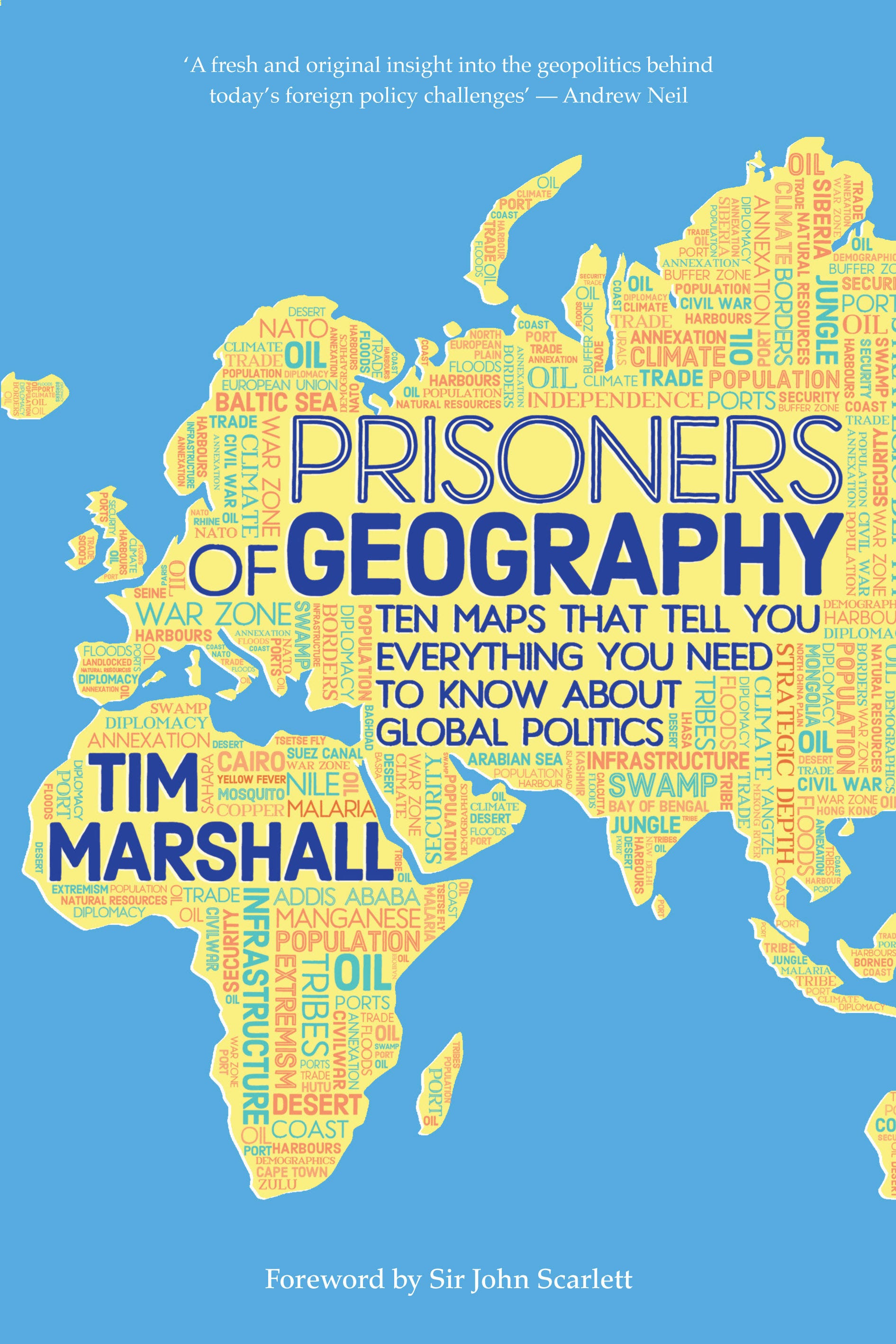
Marshall’s argument is that geography constrains what nations can do and, over long stretches of time, what they tend to do. Russia pushes toward warm-water ports because ice-locked coastlines are strategically useless. China’s borders follow natural barriers. The United States had two oceans and a continent of arable land. In dynamical systems terms, these are basins. Geography is just the energy landscape.
What I found so compelling wasn’t the geopolitics specifically. It was the underlying idea that systems, whether physical, human, or institutional, have natural tendencies. Places where they want to settle. Directions they drift toward when you stop forcing them elsewhere. This is just dynamical systems; attractor theory applied to land and power.
That thought has stayed with me. And lately, watching events unfold across domains, from the concentration of AI investment to the fracturing of multilateral institutions to the stubborn patterns of geopolitical tension, I keep returning to my nonlinear dynamics class. The basins of attraction. The natural tendencies. The question of how much we can actually engineer around them.
In physical systems, the math is clean
A ball in a bowl will always find the bottom. The geometry makes it so. This is a sink, the simplest attractor. Energy dissipates, and the system settles.

Most systems aren’t that simple, but the principle holds. Rivers find the path of least resistance. Heat flows toward equilibrium. Phase transitions happen at specific thresholds, not randomly. There’s a reason physicists talk about a system’s natural frequency or its ground state. These are the conditions a system gravitates toward when you stop fighting it.
Path dependence adds another layer. Where a system ends up depends not just on current conditions but on the history of how it got there. That’s why you can’t always reverse a process by simply removing the original cause. The system has memory. It settles into grooves.
In cities, natural tendencies are stubborn
Cities grow where geography permits, along river confluences, natural harbors, fertile plains, the old trade crossroads… and they've been doing this long before anyone thought to write a policy about it. People and capital follow favorable conditions, and once enough of them concentrate in one place, that concentration becomes its own reason to stay. A city large enough generates its own gravity.
So when a government decides to build a new capital or a new city from scratch, it’s attempting to relocate the attractor by administrative force. This works sometimes, partially. Brasília was built to pull development into Brazil’s interior. It exists. It functions. But São Paulo and Rio didn’t stop being São Paulo and Rio. The old basin didn’t disappear just because a new one was created nearby.
Egypt’s new administrative capital is under construction east of Cairo, intended to relieve congestion and signal modernization. Cairo still has 20 million people and centuries of accumulated infrastructure, institutions, and habits. Whether the new city becomes a genuine attractor or an expensive government enclave is still an open question.
I’ve been a believer in hybrid approaches to engineering urban and human systems for a long time. If you design without understanding the natural tendencies of the people and systems you’re working with, you spend most of your energy on friction. The basin keeps pulling. You can redirect it, work with its contours, and introduce new gradients. Replacing it wholesale is a different project, and it’s rarely as clean as the blueprint suggests.
In geopolitics, the basins are old
Marshall’s point is that great powers behave the way they do partly because of where they sit. He notes that Russia’s foreign policy reflects a geography with no natural western boundary and a long history of invasion from that direction. China’s historical preoccupation with its periphery reflects a continental geography that offers both buffer and exposure. The United States, with two oceans and a continent between itself and most threats, had the geographic insulation to build outward and shape a liberal international order.
Natural tendencies are constraints. They don't determine what a nation does, but they shape the cost function. A nation can act against its geographic logic, but it pays for it, and the pressure to return tends to build over time.
What this framing offers is a calibration tool. Before asking what a country should do, it helps to ask what the terrain rewards. It’s engineering literacy applied to geopolitics.
I am finalizing this post as Operation Epic Fury moves into its third day. The joint US-Israeli kinetic operations in Tehran and the confirmed death of Ayatollah Ali Khamenei represent a deliberate attempt to force a phase transition in a system that has occupied a specific basin of attraction for nearly five decades.
In dynamical systems, a system can be shocked out of its current state if the external forcing is large enough to push it over a potential barrier. The planners are essentially betting on the total collapse of the existing attractor. However, systems of this complexity rarely transition cleanly. We already see the path-dependent response. The closure of the Strait of Hormuz and retaliatory strikes on regional energy hubs are the “grooves” of the existing system reacting to preserve its ground state. The energy required to hold the Middle East in a new, engineered equilibrium will be massive.
In multilateral institutions, the question gets harder
Whether international cooperation has a natural tendency is its own attractor problem. Is convergence the equilibrium, or is fragmentation? The complexity science answer depends on the energy landscape, and right now, that landscape is shifting.
Multilateral institutions like the UN, WHO, and WTO were built on the assumption that cooperation could be made stable through rules, norms, and mutual economic interest. In dynamical systems terms, that’s an attempt to engineer a new attractor, a basin where shared governance is the equilibrium, not the exception. For several decades, the basin held.
A basin maintained by political will requires continuous energy input. Geography doesn’t. When that input weakens, the system doesn’t stay put. It relaxes toward something else.
What that something else looks like is also a question in complexity science. Fragmentation into competing blocs is one attractor. Another is a more fluid, issue-specific multilateralism. The complete collapse of institutional cooperation is a third, though probably less stable, because even adversarial states need coordination mechanisms for trade, disease, and climate.
The early-2026 withdrawals of the United States from the WHO, the Paris Agreement, and other international bodies stressed the basin. The stress revealed how much of the stability was load-bearing political will rather than structural geometry. Robust systems absorb shocks without changing form. Resilient ones reorganize and keep functioning. What we’re watching now is a test of which description applies.
The past 48 hours have offered a live illustration of this. The UN Security Council convened an emergency session within hours of the Iran strikes. The multilateral system began doing what it was designed to do: convening, issuing statements, calling for de-escalation. At the same time, retaliatory strikes had already reached Israel, Gulf states, and US military bases across the region. The gap between the tempo of events and the tempo of institutional response was visible in real time. Last weekend made that question harder to defer.
My intuition, grounded in complexity science rather than political science, is that the natural tendency of large, heterogeneous systems under stress is toward modularity. Smaller coalitions, more flexible arrangements, cooperation scoped to specific problems rather than universal governance. That may not be the world anyone designed, but it may be where the basin leads.
In AI, the basin is forming in real time
AI investment and capability are concentrating in a small number of countries and companies. That concentration has geographic and economic logic behind it. Compute infrastructure, talent, capital, and regulatory environments don’t distribute evenly. The basin is forming around wherever those conditions cluster.
At the same time, there’s enormous effort to engineer a different attractor through governance frameworks, international agreements, and calls for broader access. Some of that effort will stick, but some of it will face the same friction that any attempt to fight a basin faces.
What I find worth watching is not whether AI will be concentrated; it probably will be, at least for a while. The more interesting question is whether the attractor is stable or has tipping points built into it. Highly concentrated systems are often fragile. A basin with one deep sink and steep walls appears to be in equilibrium right up until the moment something shifts the geometry.
What natural tendencies ask of us
The pattern across all four domains is the same. Physical systems settle. Cities concentrate. Nations follow terrain. Institutions relax toward national interest when the force weakens. AI capability clusters where the conditions are best.
The work starts with understanding where the basin is. Good engineering, whether of software, cities, governance frameworks, or international agreements, begins by mapping the attractor landscape. Where does this system want to go when you stop pushing? What are the grooves already worn into it? Where are the seams where a small intervention produces durable change, and where are the walls you’ll exhaust yourself pushing against?
Some basins are genuinely worth disrupting; you just need to know the cost and stay honest about the energy required to hold the new state. The mistake is assuming you’ve moved the basin when you’ve only moved the ball.
Almost a decade after reading Marshall, I still think geography is just one version of a much older idea about how systems have preferences. The useful question is whether we’ve mapped them before we started building.