Multilateralism, Power, and the Wrong Variables
Why the resilience of institutions and the resilience of cooperation are different questions.

On Thursday, I sat down with a friend and colleague who works at the intersection of science diplomacy and anticipatory leadership. It started as a Tita afternoon over cold brew, catching up, no agenda, a bit of gossip, that then morphed into nearly two hours of probing conversation. At some point, this question came up: what does it actually mean for the natural and physical sciences to “tackle multilateralism” or “improve multilateralism”? Probing.
Here’s the thing. I’ve asked versions of that question myself; from conference stages, in panel discussions, in papers. Let’s make multilateral institutions more flexible. More resilient. Better designed. I joined that chorus more than once. Only recently did a more honest thought begin to take shape: What does that really mean? It was during this Tita conversation, not at a convention, that we said the harder part plainly.
No matter how much you improve a system, if the most powerful actor does not respect it, those improvements may fail to shape outcomes in any serious way. And if the variables we’ve been optimizing are not even the right ones, then we have a problem institutional redesign cannot fix.
I want to dig into that second point. I think many of us working at the intersection of science and diplomacy have been asking the wrong question.
Multilateralism Is Not an Institution
I went back and forth on how to start this. Then I realized I was doing exactly what I tell clients at the very beginning of any digital or AI engagement: before the investments, before the gap assessments, before the strategy gets designed, ask the most basic question first. What is this thing actually for?
So. What is multilateralism actually for?
Not what it is structurally. Not which bodies constitute it. What is the underlying purpose?
At its most basic, multilateralism is coordinated behavior between groups who have concluded that going it alone is worse. That’s it. A behavioral outcome that emerges when the cost of non-cooperation exceeds the cost of cooperation. It is less a design choice than a response to conditions.
Think about it. Trade routes existed before trade treaties. Disease containment happened before the WHO. Navigation standards emerged between competing seafaring nations because ships kept sinking without them. In each case, the institution followed the need. It codified a cooperative behavior that was already happening because the situation demanded it.
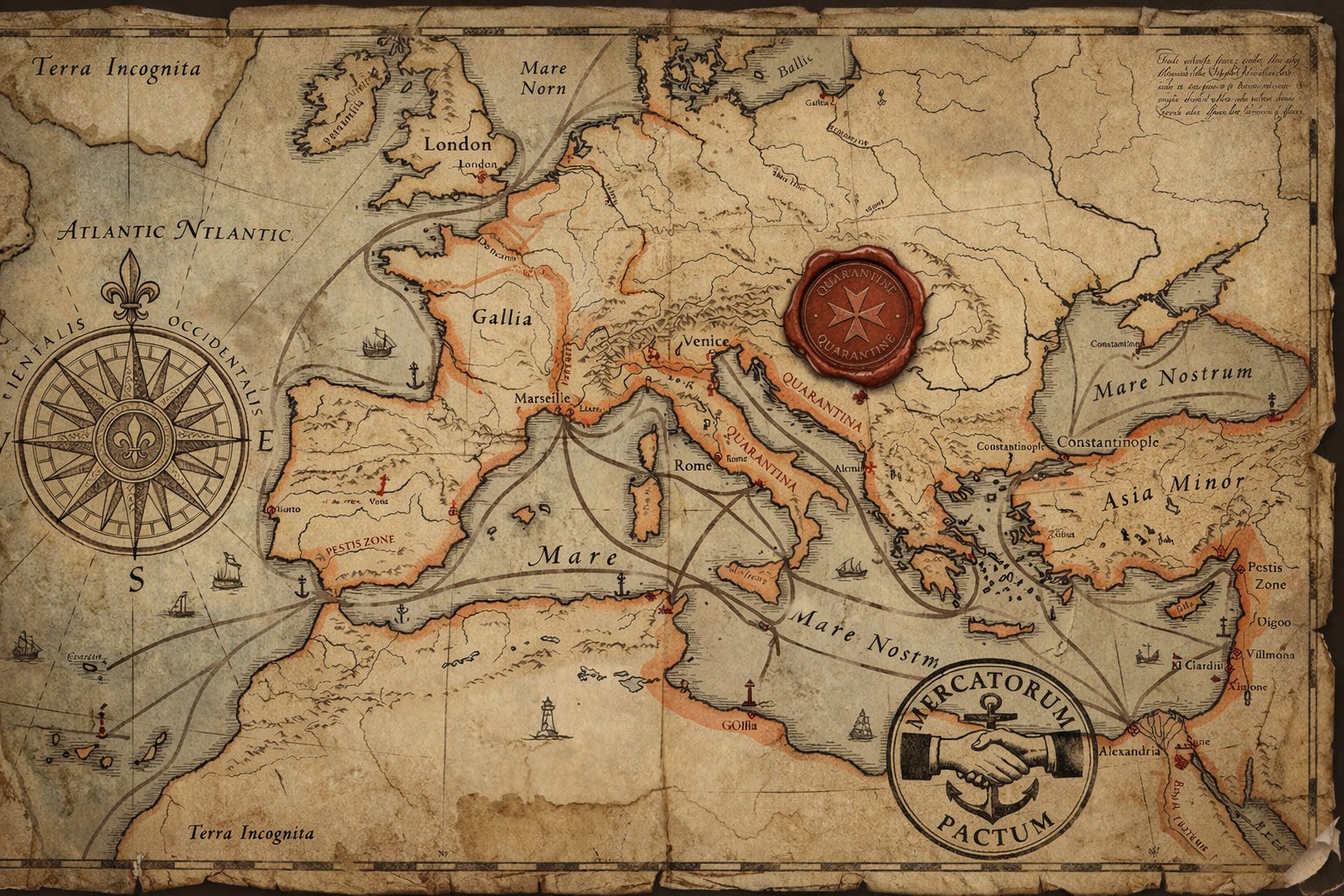
The UN did not produce multilateralism. It was produced by a multilateral moment: the postwar consensus that unilateral great-power competition had just killed 70 million people. The institution is a snapshot of that calculus. A very consequential snapshot, yes, but still… a snapshot.
Just last night, I asked someone working in policy, strategy, and diplomacy at a ministry of defense what he read of the UN Security Council right now. His view was that in active conflict, the immediate drivers are survival, strategy, and national interest. It is hard to step back and reflect when you are operating from inside those pressures. But that may be precisely the condition that has historically produced multilateral breakthroughs; the point at which the cost of the current moment becomes impossible to ignore. Seen that way, this may be a multilateral moment taking shape before any new consensus or institutional form has caught up.
If multilateralism is emergent behavior, then asking “how do we make multilateral institutions more resilient?” can sound a bit like trying to fix a company by revising its org chart. You are still focusing on the form of a prior logic instead of the conditions that produced it and the forces now shaping behavior.
The Artifact Is Not the Behavior
The G20 produces multilateral outcomes with no formal enforcement mechanism whatsoever. The IAEA functions because nuclear states find inspection regimes more useful than the alternative, not because the treaty compels them. Meanwhile, organizations with robust formal structures can be completely paralyzed; the UN Security Council is the obvious case.
So institutions are neither necessary nor sufficient for cooperative behavior between states. Which means the resilience of institutions and the resilience of multilateral cooperation are different questions. We have been conflating them. When we ask about “resilient multilateralism,” we often mean institutional durability. But durability is not the same as adaptive cooperative capacity.
This is also why the science diplomacy framing my colleague and I were wrestling with hits a wall. You can bring all the computational modeling and complexity science you want to the table. But if the purpose is to improve institutions, and institutions are not actually the locus of multilateral behavior, then the intervention is aimed at the wrong target.
The question worth asking is: what situational conditions reliably produce cooperative behavior between states?
The Conditions Come First
There’s a concept in biology called niche construction. Organisms don’t just adapt to environments; they modify them, which then steers their further adaptation. Multilateral institutions work like that, too. They are artifacts of a situation that then reshape that situation, defining what cooperation is possible going forward. The problem is we’ve started treating the construction as the niche itself. We are trying to preserve the artifact instead of asking what specific conditions produced the behavior that the artifact was meant to capture.
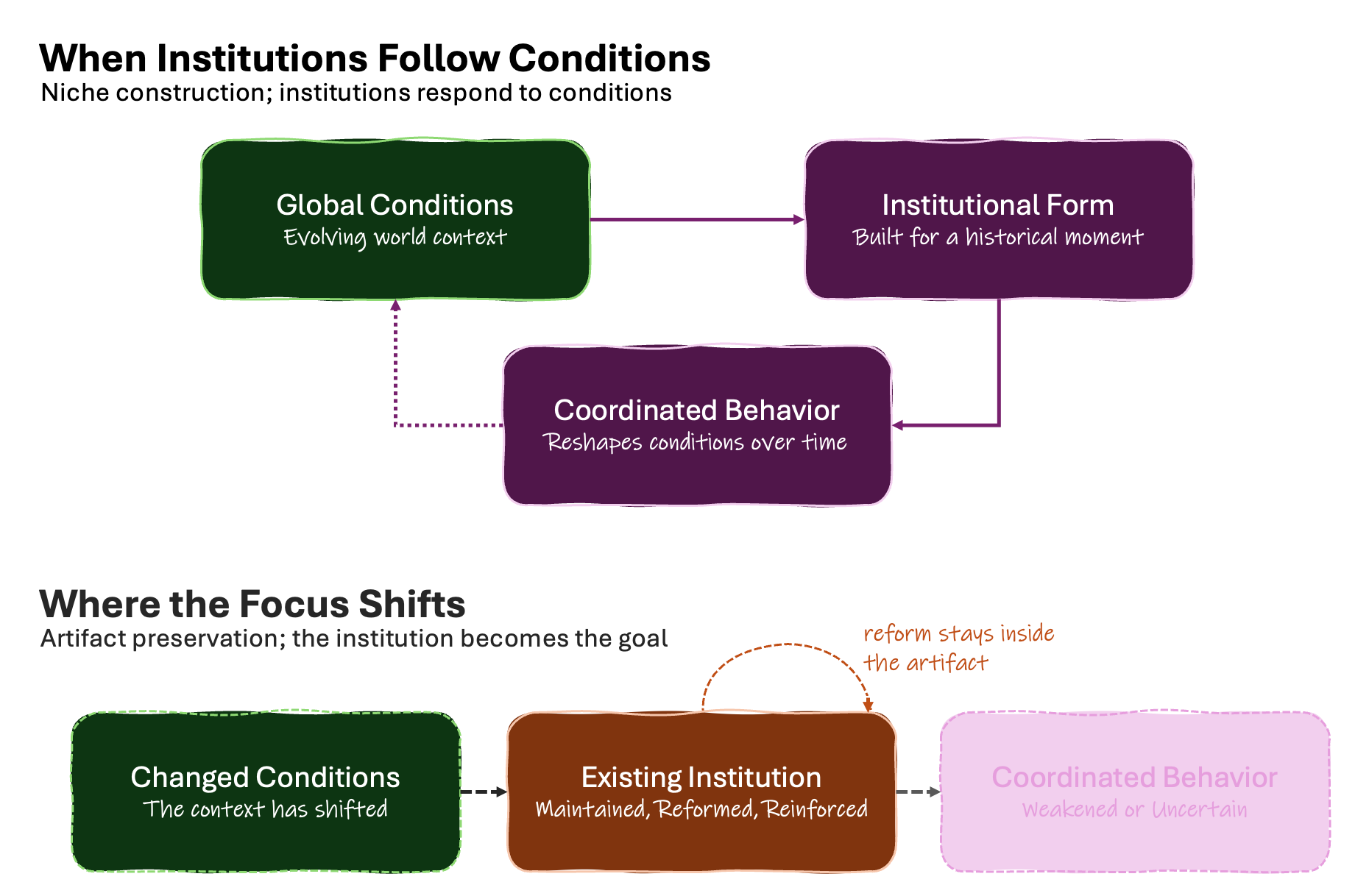
When systems evolve, the very idea of what multilateralism means evolves with them. The multilateralism of 1945 was about preventing another world war between great powers. The multilateralism of the 1990s was about economic integration and norm diffusion. What the current setting demands may look quite different from either, and there’s no guarantee it will route through the same institutional architecture.
In fact, the insistence that it must, that the path forward is reforming the UN or shoring up the WTO or patching the Paris Agreement, may be the thing that’s slowing us down. We’re defending a particular historical form of the behavior rather than asking what form that behavior needs to take now.
If that is right, then the question changes. The issue is no longer how to make legacy institutions more resilient in the abstract. It is how to preserve or build the conditions under which cooperative behavior can still emerge, adapt, and hold. That shift in emphasis matters because it leads to a different kind of practical agenda.
What This Means in Practice
This reframe has some concrete implications, and current events make them easier to see.
In January 2026, the United States withdrew from 66 international organizations, including 31 entities within the UN system. The WHO, the IPCC, the UNFCCC. The list is long. The standard reading is that this marks a crisis of institutions. But under the framing above, it reads more clearly as a signal about conditions. The institutions did not necessarily fail. The incentives that made participation attractive shifted. A state concluded that the cost of membership exceeded the benefit. That is a different diagnosis, and it points to different interventions.
The UN Security Council offers an even clearer illustration. Designed in 1945, it gives five permanent members veto power over collective action. In 2025 alone, it adopted only 44 resolutions, the lowest number since 1991. On Gaza, the Council reached a ceasefire resolution 171 days into the conflict, after multiple failed attempts shaped by competing vetoes from different permanent members, each acting in line with its own alliance commitments. On Ukraine, Russia vetoed early resolutions condemning its own invasion. In practice, the veto has often functioned less as an instrument of collective security than as a protection for national position and strategic interest. The institution reflects the strategic assumptions of the world in which it was built. The strain we see today may say as much about changed conditions as about the institution itself.
Then there is the US-Israel military operation against Iran that began in late February 2026. Whatever one’s view of its legality or justification, the structural point is straightforward: the Security Council is constrained in its ability to act because the United States, as a party to the conflict and a permanent member, can block any resolution. One of the institution’s central limits becomes especially visible in moments like this: actors it was meant to help restrain may also hold the power to prevent collective response. International legal scholars have long noted that, for populations under attack by states with Security Council vetoes, or by their allies, the limitations of the current system are hardly new. Repeated crises have simply made that structural feature harder to ignore.
In each of these cases, the cooperative behavior multilateralism was meant to produce, collective security, coordinated response, shared norms, has not disappeared. It has migrated. Coalition diplomacy, regional arrangements, bilateral channels, and informal groupings have picked up parts of the work. Indonesia’s approach of engaging both major powers rather than choosing sides. Brazil hosting COP30 and the BRICS summit in the same year. The General Assembly stepping in through its veto initiative to force debate when the Council is deadlocked. None of these replaces the original architecture. They do show that cooperative behavior can persist when the formal institution cannot carry it.
If cooperative behavior is what we are trying to cultivate, then the work that matters most right now may not lie in institutional reform alone. It may lie in preserving the conditions under which cooperation remains the path of least resistance: scientific networks, shared data infrastructure, track-two dialogues, and the informal connective tissue that institutions rest on but do not create by themselves.
So What Do We Actually Do?
This is the part where the reframe has to earn its keep. Saying “focus on conditions, not institutions” can sound like a sophisticated way of giving up. It isn’t. We are not helpless just because there are “natural tendencies.”
Later that day during our Tita catchup, another friend joined us for an early dinner. She’s an award-winning farmer. Mid-conversation, she excused herself to call a seed supplier and came back having just ordered watermelon seeds to plant within the next sixty days. When we asked, she explained it simply: the dry summer months are the wrong season for rice. You can’t force rice to grow in a dry season. So you don’t fight it. You plant watermelons instead, because watermelons thrive in exactly the conditions that would kill your rice.
She was reading what the season was giving our farmers and making an active choice about what to put in the ground.
That’s the frame. A farmer doesn’t control the weather, the soil chemistry, or the season. But a farmer is not passive either. You decide what to plant, you weed out what’s crowding the roots, you tend what’s growing, and you trust that working with the conditions produces more than fighting them ever will. The harvest isn’t guaranteed. But it doesn’t happen without someone choosing to plant.
In practice, that looks like a few specific things.
Invest in the connective tissue deliberately. Scientific networks, joint research programs, and shared early-warning systems for disease and climate may not look like governance in the formal sense, but they are often what governance rebuilds from when it has to. CERN is worth remembering here. It was founded in 1954 by twelve European nations, several of which had been at war with each other less than a decade earlier. They did not agree on politics. They agreed on a physics question. There is something deeply instructive in that. That shared inquiry became connective tissue, and it held even through decades of Cold War tension. The people who kept informal channels open between the US and Soviet Union during the same period were maintaining conditions, not running institutions. That work can be funded, taught, and sustained over time.
Build for modularity, not universality. There is a tendency to reach for one framework that covers everything and everyone from the start. In many cases, it may be more useful to build smaller, faster coalitions around problems where the situational calculus already favors cooperation: pandemic surveillance, AI safety standards, deep-sea resource governance. Let these prove themselves. Let them accumulate credibility. A minimum viable institution, tested under real conditions, may teach more than a grand framework that stalls in negotiation. This is already happening in some places; the question is whether we are doing it deliberately or simply watching it drift.
Work around structural constraints rather than waiting for them to be fixed. The UN General Assembly’s “veto initiative,” which automatically triggers a debate whenever a Security Council veto is cast, is a small but real example. It does not remove the veto. It routes around the silence. That kind of thinking deserves more attention. Parallel legitimacy structures, alternative forums, and mechanisms that keep collective deliberation alive even when the primary body is deadlocked.
Train the interpreters. The most valuable people in this space are often those who can work fluently in both languages; those who can translate between the logic of evidence and the logic of political negotiation. That is a training agenda, a curriculum design problem, and an institution-building challenge. It is also one of the more tractable ones.
Make the cost of non-cooperation visible. Cooperative behavior emerges when going it alone costs more than cooperating. Science plays a direct role here. When the IPCC quantifies the cost of inaction, when epidemiologists model the spread of a pathogen without coordinated containment, and when economists trace the spillover effects of financial contagion, they help shift the situational calculus for at least some actors. Not all. But in threshold systems, shifting some is often enough to move the whole.
None of this requires waiting for a new hegemon or for the current geopolitical moment to resolve itself. These are things that researchers, diplomats, educators, and institutions can do now, in the season we’re actually in.
One of the clearest conversations I’ve had about global cooperation happened over cold brew on a Thursday afternoon, in what was supposed to be a Tita catch-up. No conference badge. No panel. Just a couple of friends asking a better question, and a farmer who understood what it means to work with the season you have.